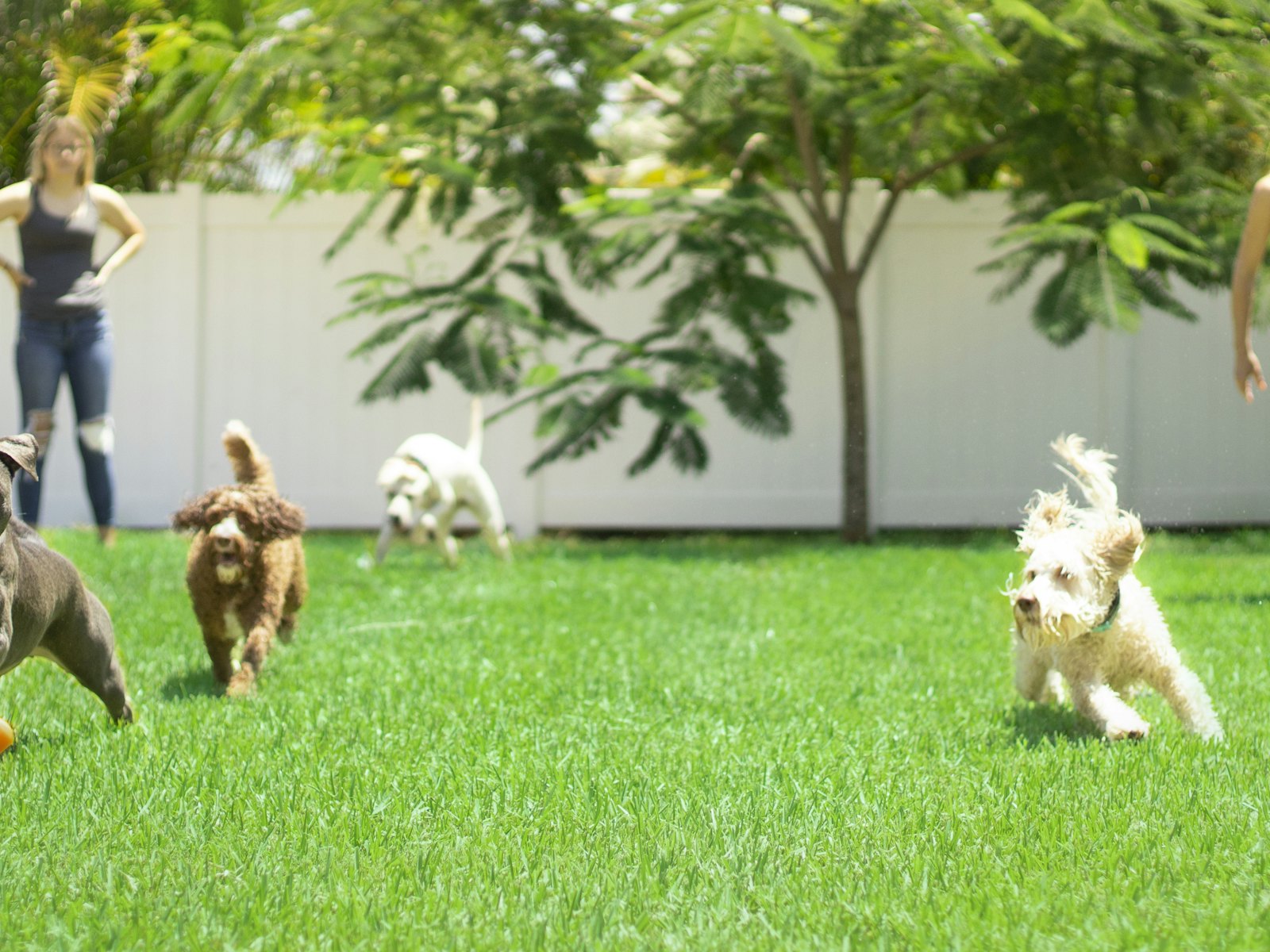
Artificial grass for dogs in Goodyear, AZ
Dogs and Arizona grass don’t mix well. Urine burns yellow spots into Bermuda, the shady corner turns to dirt, and every monsoon storm means muddy paws across the floor. Pet turf fixes all of that, but only if it’s installed with dogs in mind. A normal landscape install that looks great on day one can smell by August if the drainage and infill aren’t right.
What makes turf “pet turf”
A base that drains fast
Urine has to pass straight through the turf and the base and keep going. Pet installs use a well-compacted crushed rock base graded for drainage, and in heavy-use areas some installers add a drainage layer or deodorizing base underneath. If liquid sits in the base, bacteria grow and that’s where the smell comes from.
Permeable backing
Standard turf drains through small holes punched in the backing. Pet turf often uses a fully permeable backing that lets liquid through across the whole surface, so nothing pools between the holes.
The right infill
Infill is the sand or granules brushed into the blades. For dogs, two kinds come up most:
- Antimicrobial coated sand such as Envirofill, which is treated to resist the bacteria that cause odor and is coated so it doesn’t trap urine.
- Zeolite, a natural mineral that absorbs ammonia from urine and releases it when you rinse. It’s usually used as a bottom layer under another infill, not on its own.
Crumb rubber infill, common on sports fields, holds heat and smell and is a poor choice for Goodyear backyards.
Shorter, tougher blades
Short to medium pile turf with dense fibers is easier to clean, hides less, and stands up to running and turning. Very long, plush turf looks soft but traps waste and mats down where dogs run the same path.
Dealing with heat
This is the honest downside of turf in the West Valley. Arizona State University researchers measured artificial turf at about 152°F on a 95°F day, and readings above 170°F have been reported on Phoenix turf in mid-summer sun. Dog paws can burn on surfaces that hot. Pet owners in Goodyear usually handle it with a mix of:
- Putting the turf where it gets afternoon shade, or adding a shade sail over the dog’s main area
- A cooling infill, which can lower surface temperature when it’s damp
- A quick hose rinse before the dog goes out on hot afternoons
- Letting dogs out early in the morning and after sunset in July and August
Read the full artificial turf heat guide before you choose a product.
Keeping pet turf clean
Most odor problems come from skipped maintenance, not bad turf. A simple routine:
- Daily or as needed: pick up solid waste.
- Weekly: hose the potty area well so urine is flushed through the base.
- Monthly: spray an enzyme turf cleaner on the spots your dog uses most. Enzymes break down urine instead of covering the smell.
- Once or twice a year: power brush the turf to lift the fibers and refresh the infill. Some homeowners hire a turf cleaning service for a deep clean in spring.
Avoid pressure washers set above about 1,500 PSI and metal rakes or brushes, which can damage fibers and backing.
Dog runs and side yards
A lot of Goodyear homes have a narrow side yard that’s just dirt and gravel. Turning it into a turf dog run gives your dog a clean potty area away from the patio and keeps the main yard nicer. Dog runs get the heaviest use, so they’re where the drainage base and infill matter most. They also usually cost less because the area is small.
What pet turf costs
Installed artificial turf in the Phoenix area runs about $8 to $16 per square foot. Pet upgrades like permeable backing, deodorizing base layers and antimicrobial infill usually add $2 to $4 per square foot. A 300 square foot side-yard dog run is a very different job from a 1,200 square foot backyard, so every quote is measured on site. See the Goodyear turf cost guide for sample sizes.
Questions to ask about pet turf
- Is the backing fully permeable, or hole-punched? How fast does it drain?
- What infill will you use for dogs, and how much?
- Will you add anything to the base in the potty area?
- Does the turf warranty cover pet use?
- How should I clean it, and what products do you recommend?
Call (623) 000-0000 for a free measure. Tell us how many dogs you have and where they go, and we’ll plan the turf, drainage and shade around them.
Common questions
Will my dog’s urine smell on artificial turf?
It can if the base doesn’t drain or the wrong infill is used. Pet installs use a fast-draining base, permeable turf and an antimicrobial or zeolite infill, plus a weekly rinse and an enzyme cleaner on the potty spot. Done that way, odor is rarely a problem.
Is artificial turf too hot for dogs in summer?
In full afternoon sun, any artificial turf can get far hotter than the air temperature, well above 150°F in Arizona tests. Give dogs shade over part of the turf, rinse it before they go out on hot days and let them out early or late. See our heat guide for details.
Can dogs dig through artificial turf?
Most dogs give up quickly because there’s no dirt at the surface. The turf is secured at the edges and seams, and a compacted base underneath makes digging much harder than in a lawn.
What do I do with dog poop on turf?
Pick it up the same way you would on grass, then hose the spot. A weekly rinse of the whole potty area and a monthly enzyme cleaner keep it fresh.